 Madeira Trip Guide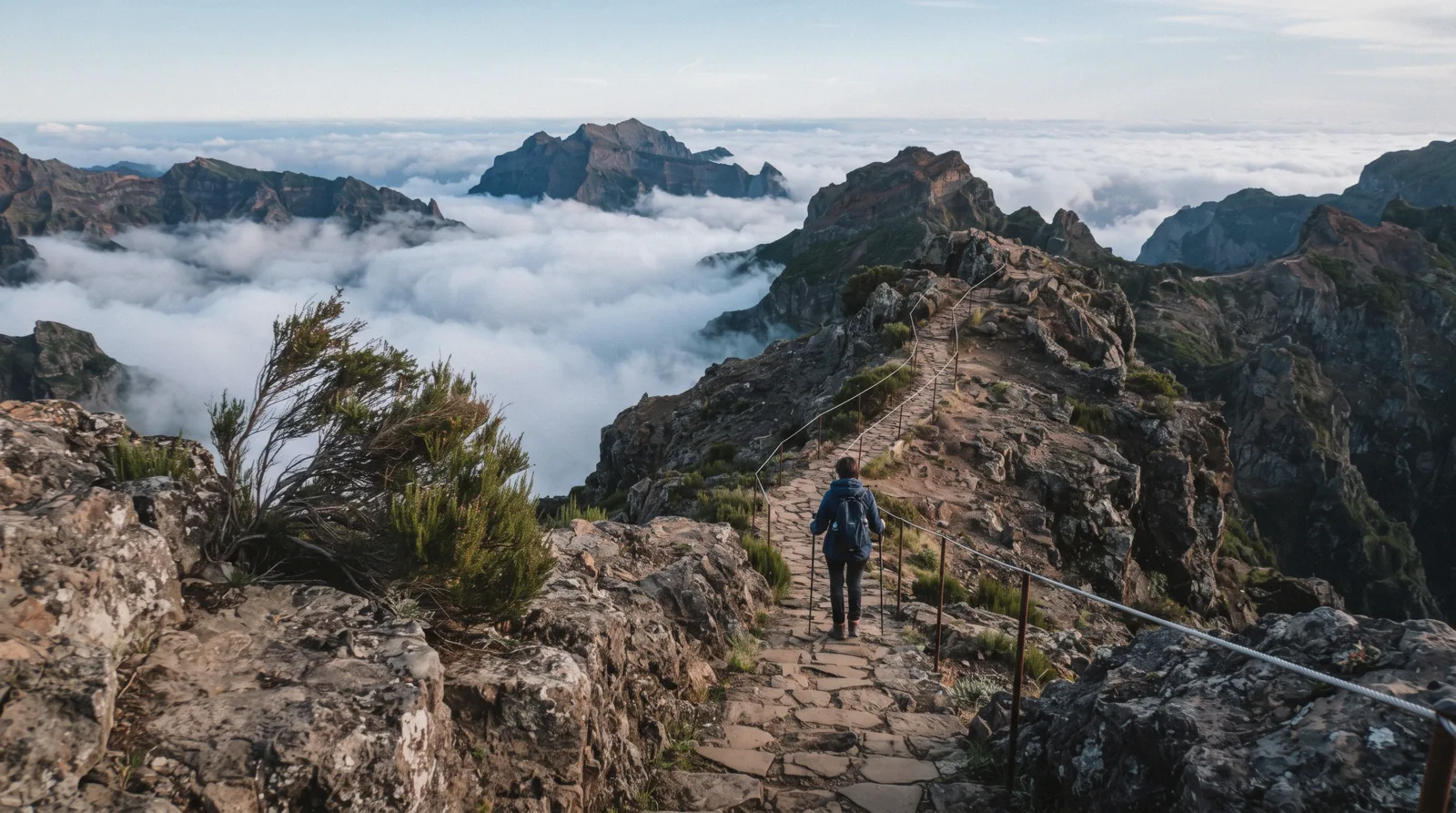
Madeira vs Azores: What the Official Figures Actually Say
Madeira vs Azores begins with one number from Portugal's national weather service. Funchal records 574.3 mm of rain a year, while Ponta Delgada in the Azores records 987.5 mm, measured at two coastal stations over the same 1991-2020 period. That gap, not temperature, is the clearest measurable difference between the two archipelagos. This page compares only what both sides publish officially: climate normals, the shape of each island group, the highest summits and the rules for walking them. Food, prices, whales and beauty are left out, because no comparable official source exists for either side. For the Madeira side in depth, start with our independent Madeira island guide and the best time to visit Madeira.
Quick answer The difference in one answer
Funchal averages 574.3 mm of rain a year against 987.5 mm at Ponta Delgada in the Azores, with 53.4 rain days against 122.3. The measurable difference is rain and rain days, not heat, since yearly average highs are 22.9°C against 20.9°C. Madeira is one main island plus Porto Santo, while the Azores are nine inhabited islands.
Key takeaways
- The rain gap is documented month by month in Madeira weather by month, built from the same Funchal station record.
- Both archipelagos now regulate their walking. Madeira's fees and booking rules are explained in trail fees and booking for the SIMplifica system.
- Madeira is one island plus a second island, and Porto Santo has its own beach and a 4x4 island tour, see the Porto Santo Island Highlights 4x4 tour.
- On the water, both archipelagos sell whale watching. The Madeira option is the ecological catamaran dolphin and whale watching trip, with no claim made here about the Azores equivalent.
Funchal, Porto Santo and Ponta Delgada Compared
The three columns below are the IPMA Normais Climatológicas 1991-2020, one published normal each for Funchal, Porto Santo and Ponta Delgada. Every figure comes from a single coastal station, so read it as a comparison of three stations rather than of two archipelagos.
| Figure | Funchal, Madeira | Porto Santo | Ponta Delgada, Azores |
|---|---|---|---|
| Average high over the year | 22.9°C (73°F) | 21.6°C (71°F) | 20.9°C (70°F) |
| Average low over the year | 17.0°C (63°F) | 16.5°C (62°F) | 15.5°C (60°F) |
| Warmest month | August 26.8°C (80°F) | August 25.7°C (78°F) | August 26.0°C (79°F) |
| Coolest month | February 19.9°C (68°F) | February 18.2°C (65°F) | February 17.4°C (63°F) |
| Rain a year | 574.3 mm | 381.7 mm | 987.5 mm |
| Days with 1 mm or more of rain | 53.4 | 61.6 | 122.3 |
| Days reaching 25°C or more | 104.1 | 63.6 | 60.8 |
| Station altitude | 58 m | 78 m | 35 m |
Three IPMA Normais Climatológicas 1991-2020, for Funchal station 522 at 58 m, Porto Santo station 524 at 78 m and Ponta Delgada / Observatório Afonso Chaves station 513 at 35 m. Each is one coastal station on one island, not an archipelago average. Neither archipelago has an official normal for its mountains. Figures current in Q3 2026.
Two Archipelagos, Different Shapes
The geography of the two island groups is documented by official tourism bodies on each side, and the difference is structural.
Madeira: One Main Island Plus Porto Santo
The Madeira archipelago consists of the island of Madeira, which holds almost all the population and the infrastructure, plus the smaller island of Porto Santo. Porto Santo is known for its long golden-sand beach and has its own set of pages on this site, starting with Porto Santo. Nearby lie the uninhabited Desertas Islands, a nature reserve where a landing requires IFCN authorisation through the SIMplifica portal, as covered under Desertas Islands.
The practical consequence is that a single base works. Most visitors sleep in or near Funchal and reach the rest of the island on day trips, and the island's main towns are listed under towns of Madeira. One rental car or one transfer network can cover beaches, levada trailheads and viewpoints from the same bed for a week. No official figure compares the two archipelagos on flight or ferry connections, so this page makes no claim about how you move between them.
The Azores: Nine Inhabited Islands
The Azores tourism board lists nine islands: Santa Maria, São Miguel, Terceira, Graciosa, São Jorge, Pico, Faial, Flores and Corvo. São Miguel is the largest of the nine, and each island is a separate destination with its own trail network, roads and services.
The practical consequence is the opposite of Madeira's. Seeing more than one or two islands means several arrivals, several bases and inter-island travel booked separately. That is not a flaw, it is the appeal for travellers who want multiple distinct destinations in one trip. It does mean more planning, and this page carries no official figure on inter-island transport, because none was published in the sources read.
For a traveller who wants one base and day trips, the single-island shape of Madeira removes that planning layer entirely. For a traveller who wants to wake up on a different island twice in a week, only the nine-island shape of the Azores offers it.
Sources: Azores islands, official tourism board, IFCN Madeira
What the Rain Figures Mean on the Ground
Temperature differences between the three stations are small. Rain differences are large, and they show up in specific months.
Ponta Delgada Is Twice As Wet, and Winter Is the Gap
Ponta Delgada records 122.3 days a year with 1 mm or more of rain, more than twice Funchal's 53.4 days. The yearly totals are 987.5 mm against 574.3 mm. The gap concentrates in the cool season. December is Ponta Delgada's wettest month at 152.8 mm, against 94.8 mm in Funchal in the same month. December also brings 15.0 rain days at Ponta Delgada against 8.6 in Funchal, so the difference is as much about how many days carry rain as about the totals.
Summer is the mirror image. Funchal's July and August are close to dry at 1.7 mm and 1.3 mm. Ponta Delgada records 26.0 mm in July and 45.8 mm in August, so its driest months are still measurably wetter than Madeira's wettest summer days. If dry summer weeks are the priority, the Funchal normal is the figure that documents them.
Heat Days and the Missing Mountain Figures
On warmth, Funchal records 104.1 days a year reaching 25°C or more, against 60.8 at Ponta Delgada. The Ponta Delgada record shows zero days of 30°C or more in the whole 1991-2020 normal, while Funchal records 2.5 such days. Neither station is hot. The difference is that Funchal crosses the 25°C line far more often.
One caution belongs in every reading of this section. These are two coastal stations at 58 m and 35 m. The interiors of both archipelagos are wetter and cooler than their coastal records. Madeira's mountain tops and north coast, and the Azores' higher ground, behave differently from Funchal and Ponta Delgada. IPMA publishes no climate normal for any mountain station in either archipelago, so no official figure exists for the high ground on either side. Anyone promising you a mountain climate statistic for Madeira or the Azores is not reading an official normal. The month-by-month coastal record for Madeira is broken down further in Madeira weather.
Sources: IPMA Funchal normal 1991-2020, IPMA Ponta Delgada normal 1991-2020, IPMA climate normals index
Walking Rules on Both Sides
Both regional governments classify and regulate their walking trails, and both regulate their highest summits. The systems differ in transparency, and the table below sets the published rules side by side.
The Two Systems Side by Side
On Madeira, the IFCN, the regional forest and nature institute, classifies the levada and mountain trails and runs booking through the SIMplifica portal. Since 1 January 2026, every classified trail needs a booked slot. On the Azores, the walking trails are a network classified by the Regional Government of the Azores, and the trail pages read state no fee and no booking requirement.
The table compares what each side publishes.
| What | Madeira | Azores |
|---|---|---|
| Who classifies the trails | IFCN, the regional forest and nature institute | The Regional Government of the Azores |
| Booking | Every classified trail on the SIMplifica portal since 1 January 2026 | Not stated on the trail pages read |
| Fee | One trail $5.17 (€4.50), full PR1 $12.06 (€10.50), 1-day pass $10.33 (€9), 3-day $25.80 (€22.50), 7-day $60.30 (€52.50). Free but still booked for residents, children 12 and under, and 60%+ disability with a companion | Not stated on the trail pages read, but the Pico mountain climb carries a mandatory fee whose amount is not published on the reserve site |
| Highest point | Pico Ruivo 1,862 m | Montanha do Pico 2,351 m |
| The big climb | PR1 from Pico do Areeiro 6.1 km, one-way past Pedra Rija, no return transport from IFCN | Pico 3.8 km with 1,150 m of ascent from Casa da Montanha at about 1,200 m, three to four hours up and the same down, GPS tracker issued, 320 climbers a day maximum, 30 at a time on the Piquinho for at most 20 minutes |
Reading the Fee Row
Read the fee row carefully. Madeira publishes its full price list openly. The Azores trail pages read publish no fee and no booking rule, but the absence of a fee on those pages is not proof that no Azores trail charges.
It only means the pages read did not state one. The Pico reserve site separately confirms a mandatory fee for the mountain climb, with the amount not published on the page.
Climbing the Two Summits
Mount Pico in the Azores is the higher summit at 2,351 m, and the reserve's rules are detailed. The trail climbs from Casa da Montanha at about 1,200 m to the Piquinho, about 3.8 km with 1,150 m of height gain. Ascent and descent each take about three to four hours on average. Climbers are issued a GPS tracker, the reference capacity is 160 visitors on the mountain at once with a maximum of 320 a day, and the Piquinho takes 30 people at a time for 20 minutes at most. The reserve site adds that the summit is as a rule 10 degrees colder than sea level and that descent should start at least four hours before sunset.
Madeira's high point, Pico Ruivo at 1,862 m, is reached through the same SIMplifica booking system as every other classified trail, with the PR1 ridge walk from Pico do Areeiro as the classic route. IFCN states plainly that it provides no return transport from the trail, so walkers finish at Achada do Teixeira or walk back the way they came. Madeira's own summit facts sit on Pico Ruivo and the start point on Pico do Arieiro, and hikers doing PR1 independently often use the Funchal Pico do Arieiro Sunrise Hiking Transfer to reach the start before dawn.
The two climbs are not ranked here. One is higher with a stricter cap and an unpublished fee. The other is lower with a published fee schedule and a booked slot on every trail. Both require planning in advance, which is the fact that matters for booking a trip.
Sources: Mount Pico official reserve site, IFCN Madeira, Azores walking trails
What Madeira Has That This Guide Can Show
This is a Madeira guide, so the Madeira side comes with detail the Azores side does not get here. Every figure below is sourced. No comparison claims are made in this section.
The Levada Network and Its Booked Slots
Madeira's signature walking is the levada network, the water-channel paths that cross the island's slopes. Since 1 January 2026 every classified trail needs a SIMplifica booking, so a levada walk is now a planned walk, not a turn-up walk. The system, the fees and how the booking works are explained in levada walks, and the best-known single trail is covered under Levada das 25 Fontes.
For the Rabaçal trailhead specifically, the Rabaçal 25 Fontes and Risco Levada hiking transfer covers both waterfall routes with a map and pickup rather than a guided group.
The Laurel Forest and the North-West
The Laurisilva of Madeira, the island's laurel forest, was inscribed by UNESCO in 1999. The Fanal plateau, where Porto Moniz council describes centuries-old Til trees on the high ground, is covered under Fanal forest. On the north-west coast, the Porto Moniz natural pools charge $3.44 (€3) to enter, and the details sit on Porto Moniz.
The same corner of the island is reached by the Madeira Skywalk, Porto Moniz, Seixal and Fanal 4WD tour, an open-roof full-day route that also stops at Seixal and Ponta do Sol. Above the south coast, the Cabo Girão glass skywalk viewpoint costs $5.74 (€5) booked on SIMplifica, open daily from 08:00 to 20:00, under Cabo Girão.
Funchal as a Base
The capital works as a single base for the whole island, with its own attractions inside the city. A cable car rises from the centre towards Monte, described under Funchal cable car, and the classic descent from Monte is the wicker toboggan run at Monte toboggan. The city's produce market is the Mercado dos Lavradores.
The full city coverage, including the old town and evening options, starts at Funchal. A week on Madeira can be built entirely from this base, which follows from the one-main-island shape described above.
Sources: UNESCO Laurisilva of Madeira, IFCN Madeira
What Cannot Be Compared Here
The honest part of any comparison page is the list of things no source supports.
Where No Comparable Official Figure Exists
No official source ranks the two archipelagos against each other, and none was found. No comparable official figures were found for prices, restaurants, whale sightings, beaches or accommodation covering both sides, and this page invents none. Any statement that one archipelago is prettier, friendlier, cheaper or better for food than the other is opinion, and the published record read for this page contains no data that could turn opinion into fact.
Whale and dolphin trips run from Funchal and are covered properly under whale watching in Madeira. The Azores also markets whale watching, but no official figure comparable to the Madeira side was read for this page, so no claim is made here about the Azores. An example of the Madeira trip is the ecological catamaran dolphin and whale watching trip, an electric-assisted catamaran with land-based spotters guiding the route.
Costs on the Madeira side, where any figure can be sourced, are set out in what Madeira costs. The same work has not been done here for the Azores, so no price comparison between the two appears on this page. That silence is deliberate. If a future official source publishes comparable figures for both archipelagos, this section will shrink.
How to Decide Without a Ranking
What follows is our reading of the published figures, stated as decision rules rather than verdicts.
Four Rules Tied to Sourced Figures
Each rule below rests on a figure already sourced in this page. Each is our reading of that figure, not an official recommendation.
- If dry summer weeks matter most, the Funchal record shows 1.7 mm of rain in July and 1.3 mm in August, against 26.0 mm and 45.8 mm at Ponta Delgada in the same months. The driest published summer is the Madeira one. - If you want one base and no island hopping, Madeira is one main island plus Porto Santo, while the Azores are nine inhabited islands where each island is a separate arrival. - If the highest summit is the point, Mount Pico in the Azores is 2,351 m against Pico Ruivo's 1,862 m, with a 320-climber daily cap and a mandatory fee on the Pico climb. - If you want a booked slot system with published prices you can read before you travel, Madeira publishes its full trail fee list, from $5.17 (€4.50) for one trail to $60.30 (€52.50) for a 7-day pass, on the SIMplifica system. - If you want the mildest published year-round figures, Funchal's yearly average high of 22.9°C (73°F) is the highest of the three station normals, with 104.1 days a year reaching 25°C or more.
None of these rules says which archipelago is better. They say which published figure matches which priority, and the traveller applies them to the trip in mind.
Sources: IPMA Funchal normal 1991-2020, IPMA Ponta Delgada normal 1991-2020, Mount Pico reserve, IFCN
What You Can Book on the Madeira Side
These are the operator's listed US dollar prices and durations, shown on each card. They cover the high points, the levadas, the north-west, the sea and Porto Santo.
 from $79.00
Madeira Skywalk, Porto Moniz, Seixal & Fanal 4WD Tour
A full-day open-roof Land Rover tour reaching Porto Moniz, Seixal, Fanal forest and Ponta do Sol, with a lunch break and free pickup.
Check Availability from $56.00
Funchal Pico do Arieiro Sunrise Hiking Transfer
A transfer-only package to Pico do Arieiro for sunrise, with a later pickup from Achada do Teixeira for hikers doing the PR1 trail on their own.
Check Availability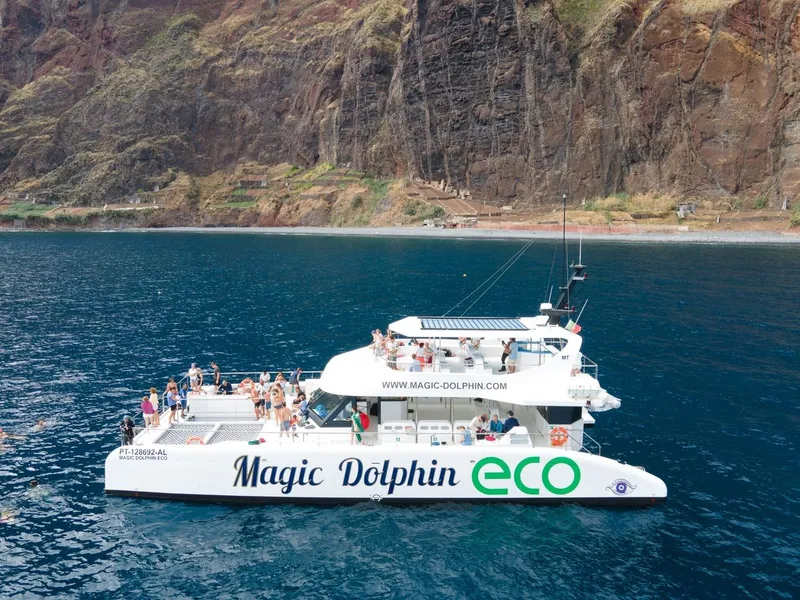 from $40.00
Ecological Catamaran Dolphin and Whale Watching
An electric-assisted catamaran trip off Funchal with land-based whale spotters, two decks and wheelchair-accessible toilets.
Check Availability from $50.00
Rabaçal: 25 Fontes & Risco Levada Hiking Transfer
A transfer to Rabaçal covering both the 25 Fontes and Risco waterfall levadas, with a route map instead of a guided walk.
Check Availability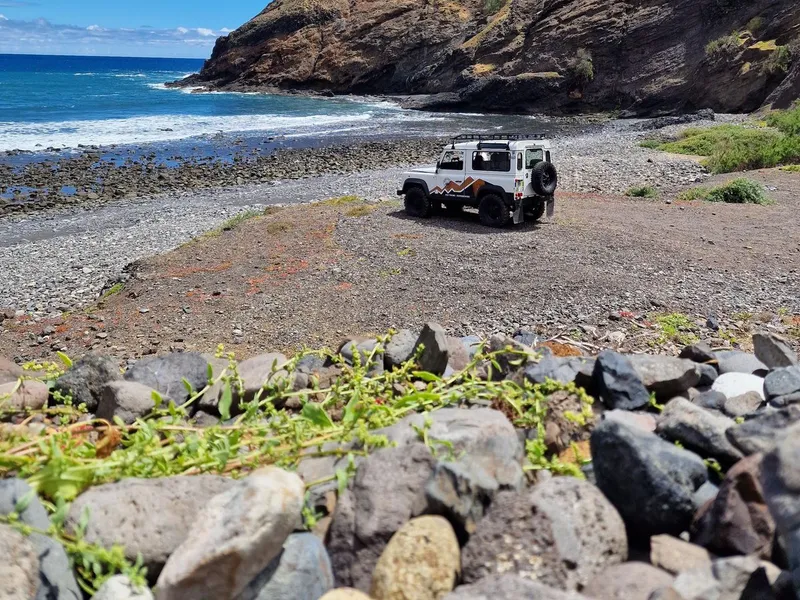 from $57.00
Porto Santo Island Highlights 4x4 Tour with Hotel Transfers
A 4x4 tour of Porto Santo's highlights, including its 9km golden-sand beach, with hotel pickup once on the island.
Check AvailabilityPrices, ratings and details are the platform's own. dollar figures are the listed prices — the platform bills in your account's currency.
Keep Planning Madeira
Pages on this site that carry the Madeira side of the comparison in more depth.
Madeira Weather
The full month-by-month breakdown of the Funchal and Porto Santo station records behind the rain figures above.
Best Time to Visit Madeira
Turns the same climate normals and the event calendar into a decision about which weeks to book.
Porto Santo
Madeira's second island, with its own climate normal in the comparison table and a long golden beach.
Madeira Hikes
The classified trail network, including Pico Ruivo and the levadas, with the booking rules for each.
Madeira vs Azores: Questions
Which has better weather, Madeira or the Azores?
The official figures support a narrower statement than better or worse. Funchal averages 22.9°C (73°F) yearly highs against 20.9°C (70°F) at Ponta Delgada, and 53.4 rain days against 122.3. Funchal is warmer and drier in the published record, which is not the same as better, since some travellers prefer greener landscapes that come with rain.
How many islands do the Azores have?
The Azores tourism board lists nine islands: Santa Maria, São Miguel, Terceira, Graciosa, São Jorge, Pico, Faial, Flores and Corvo. Madeira, by contrast, is one main island plus Porto Santo, with the uninhabited Desertas nearby.
Is the Azores wetter than Madeira?
At the two compared coastal stations, yes. Ponta Delgada records 987.5 mm of rain a year against Funchal's 574.3 mm, and 122.3 rain days against 53.4. December is Ponta Delgada's wettest month at 152.8 mm against Funchal's 94.8 mm. These are single coastal stations, and both interiors are wetter than their coasts. The month-by-month record is in Madeira weather.
Which has the higher mountain?
Mount Pico in the Azores is higher at 2,351 m, against Pico Ruivo on Madeira at 1,862 m. The Pico climb starts at Casa da Montanha at about 1,200 m and involves 3.8 km with 1,150 m of ascent, a GPS tracker, a maximum of 320 climbers a day and a mandatory fee. Madeira's PR1 to Pico Ruivo runs 6.1 km from Pico do Areeiro with a SIMplifica booking, see Pico Ruivo.
Do you need to book trails in Madeira and in the Azores?
In Madeira, every classified trail needs a booking on the SIMplifica portal since 1 January 2026, with fees from $5.17 (€4.50) for one trail to $60.30 (€52.50) for a 7-day pass, detailed in trail fees and booking. On the Azores trail pages read, no booking requirement was stated, but the Pico mountain climb separately requires a mandatory fee and operates under a daily cap. The absence of a fee on the Azores trail pages read is not proof that no Azores trail charges.
Which one should I choose for a first trip?
This page states rules, not a ranking, because no official source ranks the two. If one base without island hopping and the driest published summer suit you, the figures favour Madeira's shape and Funchal's record. If a higher summit and a nine-island archipelago suit you, those are documented Azores facts. Apply the decision rules in how to decide to your own priorities.
Madeira and the Azores on Film
Three videos that put the two archipelagos side by side, filmed in both.
Madeira or the Azores - Which island group impressed us more? Costs, nature, activities
Two travellers weighing the same choice this page frames with figures.
Video: The.Beach.OfficeAzores & Madeira, PORTUGAL - the islands that will capture your heart
Footage from both archipelagos, useful for seeing the landscape difference.
Video: Rocky RaeAzores vs. Madeira Which Portuguese Island is Better?
A comparison video, to set against the published record above.
Video: HR VIRTUAL TOURVideos load from YouTube only when you press play.
Prices, hours and terms are set by the venue or operator and confirmed at checkout.
We may earn a commission if you book through one of our links, at no extra cost to you. Full affiliate disclosure